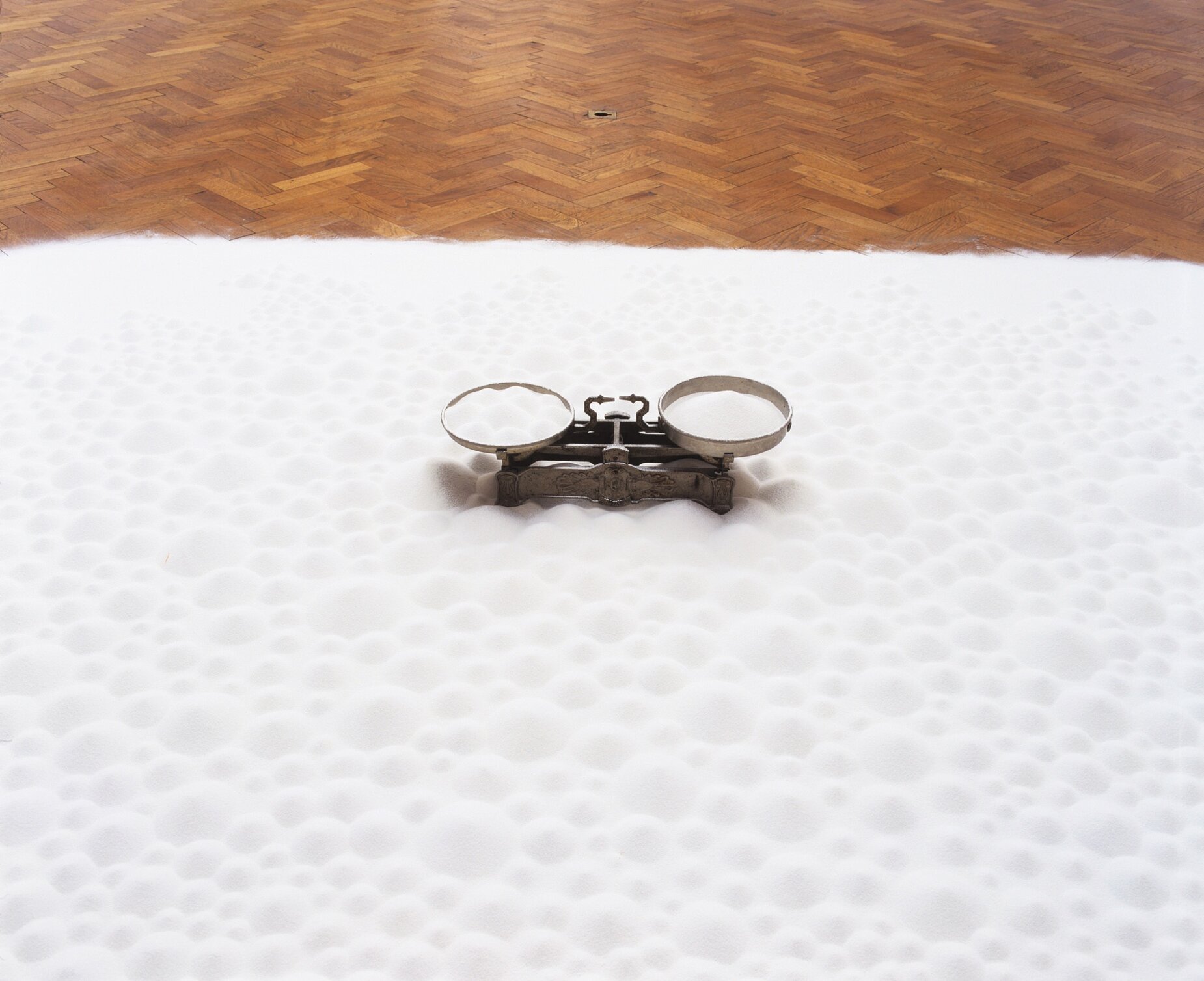
Black on white. The eye has the form of a sphere; what is more interesting: to look out, or look in? Frequently the inner world is larger and wider than the outer one; it is full of coverings, concealments, limitations, and it tends to become more and more finite, unchangeable. But it is non-wholeness that must be brought to light, while the closed circle of both worlds (ideas/looks) must be shaken, opened for both “opposite” sides. For the spirit and for the eyes.
Neither architecture nor ornament are any longer simply domesticated, simply “home”. As structures in substance and space they can be conceived in imaginary notions, not only as the occupying of space, a formation in space, but as matter on its way to light, to openness. An illusion is not necessarily a deception. The inner space is a frame composed of and filled with various gestures, interventions, and contents, but these take increasing account of the open orientation of enclosed space. When decoration is not merely functional, the inner space, lit with windows, becomes an imaginary space, larger and wider than even itself, and frequently it surpasses human patterns and ideas. What is dominant and what subordinated, and what is subordinated and what dominant in the continuous representation?
Traditionally, architecture provided a framework for decor viewed by many as decorative trash, and consequently architecture was considered to be the perverse agent of “wild imagination” instead of merely a roof over the head and a protection for the body. Despite the multiple death of ornament it seems that it persists, also in a repetitive form which, however, is not merely always the same returning. A hole, a room without windows or doors ... this is a perfect prison without surveillance, but it does not yet exist; the fear of death is also the fear of losing sight, and even coffins are “open”, decorated both outside and inside. And the gallery reminds us primarily of a guest room, a room for visitors/ viewers, so it is not a sleeping room, or a dreaming room, or a kitchen – however, it is no longer merely a trap for the view, but a trap for the body (and “its” imagination).
Art – of course – has not frequently been drawn to simplification, precision, simplicity, distinctness ... It is primarily an escape into the unknown, and then back again through the view into the perceptible world. It is the “elevated”
work of transition and loss of memory, where a person is but a mask of the subject. Does art have a human face, is it “of human measure”, or is it “merely”
human art, something in which the subject is still inscribed and still remains written – “visible”? Bellevue.